
Hey everyone,
We spend an awful lot of time talking about artificial intelligence at StudioOps. Models, creative memory, Blooms, expanded creative surface area, and all the other things that come with building an AI platform for musicians. So I thought it might be worth reminding everyone that we actually make music here, too. 😂
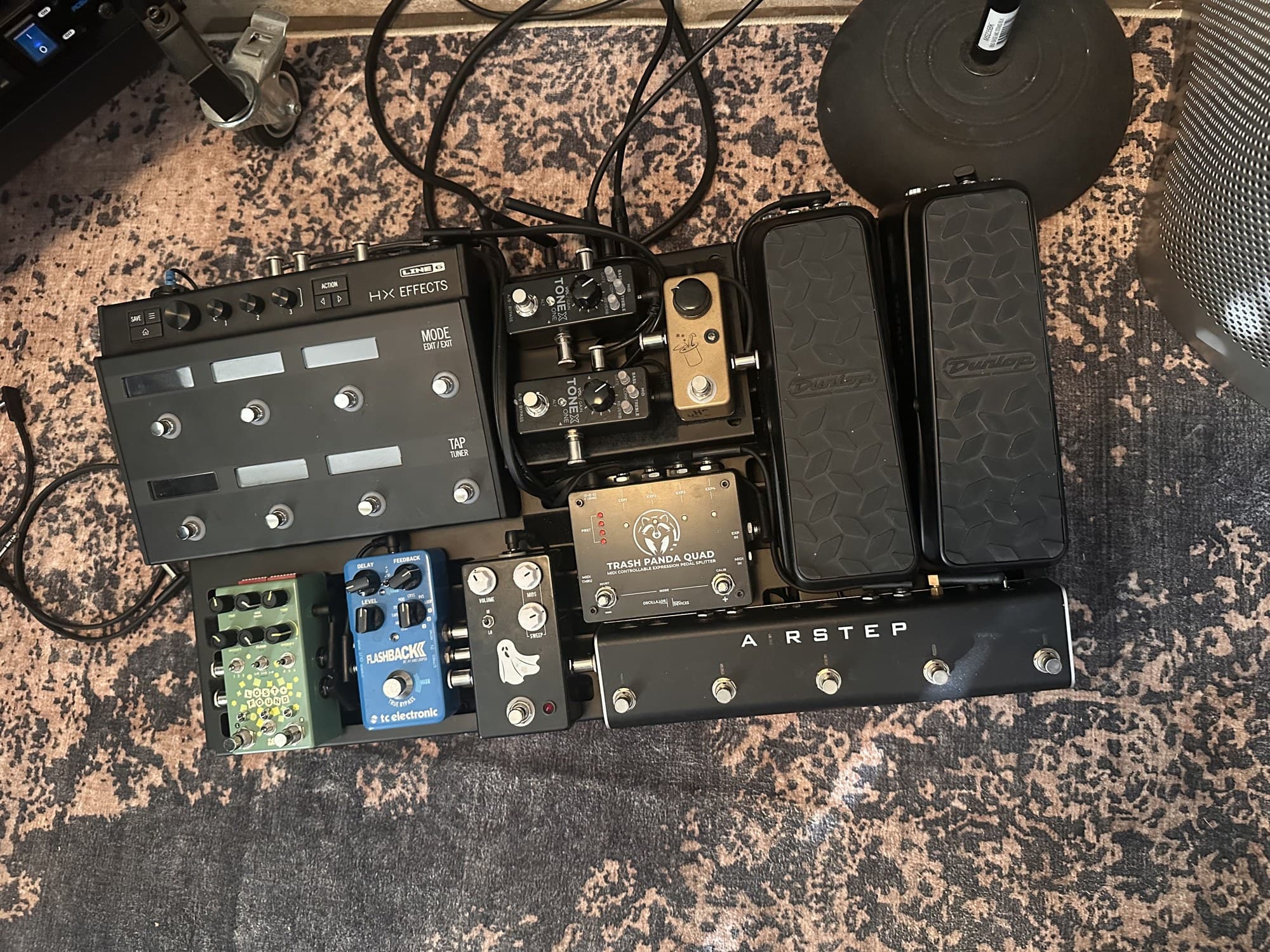
The photo above is a pedalboard we've been putting together over the past several months. It's a collection of effects processors, expression pedals, controllers, and a few other toys that probably looks like a fairly typical guitar rig to anyone who's spent enough time around musicians. And for the most part, that's exactly what it is. But it's also becoming part of a larger experiment involving artificial intelligence, live performance, and audience participation.
We could have gone with another Pedaltrain board, which would have been the quick and familiar option. But we really liked the modular approach RockBoard takes, particularly the ability to add different MOD units without having to tear apart and reconfigure the entire rig. We ended up choosing a setup that lets us incorporate wireless connectivity and flexible audio routing through the board itself. It's a relatively small detail, but I love that kind of design. Someone thought about how musicians actually use their equipment, anticipated that their needs might change, and built a system that could accommodate those changes without requiring them to start over.
I've spent a good portion of my life making music, and one of the things I've always enjoyed is the relationship between musicians and the equipment they use. There's something satisfying about putting together a rig, experimenting with different combinations of effects, and discovering sounds you weren't necessarily looking for. A particular delay setting might suggest a rhythmic idea, or an unfamiliar texture might lead you toward an entirely different arrangement. You start out trying to accomplish one thing and end up somewhere else entirely. I've lost entire afternoons doing exactly that, usually when I was supposed to be working on something else.
That experience has a lot in common with what we're trying to accomplish at StudioOps.
One of the questions we're pursuing is what happens when the creative process doesn't necessarily end with a finished song. We've spent a lot of time developing ways for AI to help artists work through ideas, uncover connections, and broaden their creative vocabulary. That's essentially what Signal and the Bloom are designed to do. But what happens to all those directions an artist considered along the way? Do they simply become part of the creative history of the recording, or could they continue to influence how that song evolves?
We're experimenting with the idea of building a live performance around the Bloom itself, using AI to introduce new musical directions while the artist is performing. We're also curious about how the audience might participate, potentially influencing the course of a performance rather than simply watching it unfold. Imagine a musician responding to ideas that emerge from the Bloom in real time, with the audience helping determine which directions are worth pursuing. The musician still has to interpret those ideas, decide what to play, and make the whole thing work musically. But the creative environment becomes considerably more dynamic.
And that's where the pedalboard comes in.
One of its more unusual components is the **Chase Bliss Lost + Found**, a small-run effects pedal with an almost ridiculous range of sonic possibilities. It's an extraordinarily specialized piece of equipment that relatively few musicians use, and part of its appeal is how much there is to discover simply by experimenting with it. You can approach it with a particular sound in mind and end up somewhere completely different. For a performance built around the idea of discovering and following unexpected creative directions, it's a pretty natural fit.
We're also running **two IK Multimedia TONEX One pedals**, which split our guitar signal into separate amp paths and give us considerably more flexibility in shaping the sound. Having two independent amp voices opens up combinations that wouldn't be possible with a single path, and we're looking at ways to take that further through MIDI-controlled switching with the Line 6 HX Effects. Being able to move between different amp configurations as part of a performance would give us another dimension to work with, particularly if those changes could eventually become part of the broader interactive system.
Of course, there's a practical problem to solve first.
We could upgrade to newer TONEX hardware to get some of the functionality we're after, but we're considering dusting off the soldering iron and 3D printing some custom pedal mounts to make the equipment we already own work the way we want. There are some technical details to figure out, but the prospect of designing and building our own solution is appealing. There's a particular satisfaction in understanding a piece of equipment well enough to modify it, and the fabrication process is something we'd enjoy in its own right.
That probably tells you something about how we approach things at StudioOps. We're building an AI platform, but we're also musicians, engineers, and people who enjoy making things. I like figuring out how different components might interact, experimenting with configurations that weren't necessarily anticipated by their designers, and occasionally spending far more time solving a problem than it would have taken to simply buy something that already solves it. There's a fine line between craftsmanship and making life unnecessarily difficult for yourself, and I'm sure we've crossed it more than once.
There's a connection here to the way we've been approaching the Bloom.
A Bloom takes an artist's original idea and develops a network of relationships around it, including musical references, emotional themes, production approaches, and other creative material. The value comes from how those elements interact and what the artist discovers by moving between them. Something that initially seems unrelated might change how you understand the original idea, or suggest a musical direction you hadn't considered.
The pedalboard operates on a similar principle, albeit in a much more physical way. Each piece of equipment has its own capabilities, but the real fun begins when you start combining them. A particular amp sound might behave differently through an unusual effect. Changing the order of two processors can produce an entirely different result. And with enough control over those combinations, you can create a system that responds to the way you want to play rather than requiring you to work around the limitations of individual devices.
Now imagine extending that approach into a live performance where the Bloom, the musician, and the audience are all contributing to what happens next.
The audience component is especially intriguing to me. Traditionally, the relationship between a performer and an audience is largely one-directional, at least in terms of the music being played. Obviously, audiences influence performances through their energy and reactions, and improvisational music has a long history of responding to the room. But what happens when listeners can participate more directly in the creative decisions being made? Could the same song develop differently depending on who's in attendance? Could the Bloom become a shared environment where the musician and audience discover new musical directions together?
There are plenty of ways this could go wrong, of course. Live performance is already complicated enough without introducing an AI system and asking the audience to participate in the creative process. Timing matters. Reliability matters. And whatever interaction we introduce has to contribute something musically worthwhile. The last thing I want is to interrupt a good performance so everyone can watch a technology demonstration.
I've always thought the best technology eventually becomes something you stop thinking about. You don't consider the circuitry inside a delay pedal when you're playing guitar. You hear something you like, turn a knob, and follow it. I'd love for our work with AI to feel that natural. The musician shouldn't need to understand the models or software operating behind the scenes any more than they need to understand the algorithms inside a digital effects processor. Ideally, the technology becomes another part of the instrument, something you can interact with intuitively while remaining focused on the music.
That's one of the more demanding aspects of what we're proposing. It's relatively easy to imagine a system that generates musical suggestions during a performance. Making those suggestions useful, presenting them at the right moment, and allowing a musician to act on them without breaking concentration is an entirely different problem. Add audience participation, and the design becomes even more complicated. But those constraints are also what make the experiment worth pursuing.
We've spent an enormous amount of time at StudioOps figuring out how to make AI useful during songwriting and production without getting in the artist's way. Taking those ideas out of a software interface and into a physical performance environment gives us an opportunity to test that philosophy under very different circumstances.
Some of our ideas will undoubtedly turn out to be impractical. Others might work technically but contribute very little to the music. I'm fine with that. We'll experiment, keep what works, and change or discard what doesn't. There's no reason to complicate a performance unless the result justifies the effort.
What I like most about this project is how naturally it brings together so many things I've enjoyed throughout my life: making music, building technology, experimenting with equipment, and figuring out how to make disparate pieces work together.
After all the time we've spent developing sophisticated AI systems, it's amusing that part of our next experiment might involve a soldering iron, a 3D printer, and a pedalboard full of equipment that was never designed to work together in quite this way.
And if nothing else, I apparently have another excuse to buy more guitar pedals.
Talk soon,
Todd